
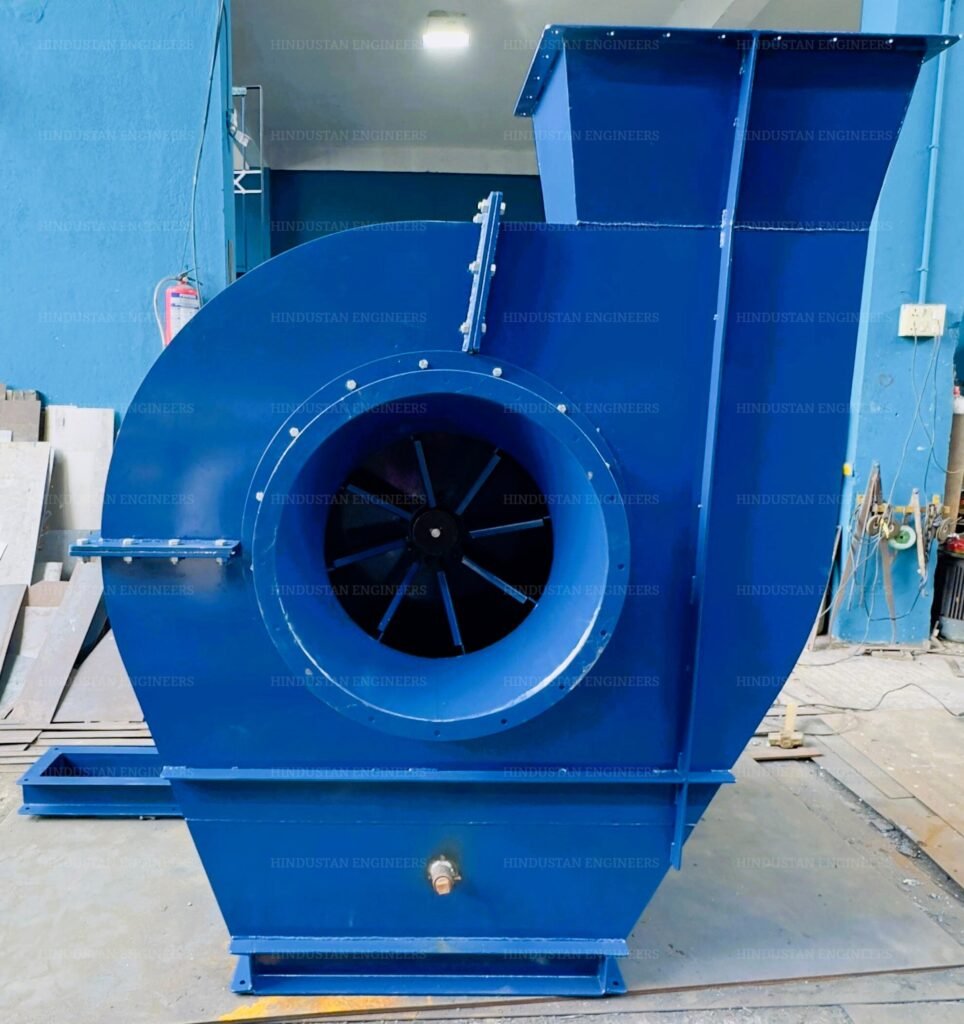
A heavy-duty industrial blower is a powerful air moving device designed to create high airflow and pressure for various industrial applications. These blowers are commonly used for ventilation, cooling, drying, dust control, material handling, and air filtration in industrial facilities, construction sites, manufacturing plants, and other large-scale operations.
The blower generates airflow by drawing air into the system and propelling it through the ductwork, filters, and other components of the dust collection system. The high-speed movement of the air created by the blower helps to capture and carry away airborne particles, ensuring they are effectively contained and collected.
The size and capacity of the dust collector blower are important factors to consider when selecting a dust collection system. The blower must be capable of providing sufficient airflow to match the requirements of the system and to maintain proper performance. Factors such as the size of the facility, the number of dust-producing processes, and the type of particles being captured will influence the blower’s specifications.
It is worth noting that different types of blowers, such as centrifugal fans or axial fans, can be used in dust collection systems, depending on the specific application and requirements.
When choosing a dust collector blower, it is essential to consider factors such as the required airflow volume, the static pressure needed, energy efficiency, noise level, and any specific requirements for the application.
Fan blades
The fan wheel consists of a hub with a number of fan blades attached. The fan blades on the hub can be arranged in three different ways: forward-curved, backward-curved or radial.
Forward-curved
Forward-curved blades, curve in the direction of the fan wheel’s rotation. These are especially sensitive to particulates and commonly are only specified for clean-air applications such as air conditioning. Forward-curved blades provide a low noise level and relatively small air flow with a high increase in static pressure.
Backward-curved
Backward-curved blades, curve against the direction of the fan wheel’s rotation. Smaller blowers may have backward-inclined blades, which are straight, not curved. Larger backward-inclined/-curved blowers have blades whose backward curvatures mimic that of an airfoil cross section, but both designs provide good operating efficiency with relatively economical construction techniques. These types of blowers are designed to handle gas streams with low to moderate particulate loadings. They can be easily fitted with wear protection but certain blade curvatures can be prone to solids build-up. Backward curved wheels are often heavier than corresponding forward-curved equivalents, as they run at higher speeds and require stronger construction. Backward curved fans can have a high range of specific speeds but are most often used for medium specific speed applications—high pressure, medium flow applications. Backward-curved fans are much more energy efficient than radial blade fans and so, for high power applications may be a suitable alternative to the lower cost radial bladed fan.
Straight radial
Radial blowers, have wheels whose blades extend straight out from the centre of the hub. Radial bladed wheels are often used on particulate-laden gas streams because they are the least sensitive to solid build-up on the blades, but they are often characterized by greater noise output. High speeds, low volumes, and high pressures are common with radial blowers[citation
needed], and are often used in vacuum cleaners, pneumatic material conveying systems, and similar processes.
Impeller entry
Flow at the intake and its turning from axial to radial direction causes losses at the intake. Friction and flow separation cause impeller blade losses since there is change in incidence angle. These impeller blade losses are also included in the category.
We manufacture a range of centrifugal fans that are widely used in various industries for moving air or gases. Designed with precision using graded components, our rage of centrifugal fans are widely appreciated for their high efficiency, low energy consumption and long functional life. These fans are also quality tested by us on various parameters to meet the set industrial standards.